Short answer: Junior mining companies are small listed companies that explore for mineral deposits or develop them, usually with no revenue at all. Their shares are cheap, thinly traded and driven by drill results, financing and sentiment. A few rise a hundredfold on a discovery. Most never build a mine, and many lose almost everything.
This article is for information only. It is not investment advice, and nothing here is a recommendation to buy or sell any security. Junior mining shares are among the riskiest securities on any stock market. Do your own research and, if you need advice, speak to a qualified adviser.
What a junior miner is
The mining industry divides roughly into two kinds of company. Majors and mid-tier producers run mines and sell metal. Juniors look for the deposits that the producers will one day buy.
A junior typically owns or options a handful of exploration properties, employs a few geologists and a chief executive, and spends almost all of its money on drilling, sampling and studies. It has no revenue. It pays for everything by selling new shares, again and again.
Juniors come in three broad stages:
- Grassroots explorers are testing ideas: a geological model, an old showing, a soil anomaly. Most of their value is hope.
- Discovery-stage explorers have hit something in the drill core and are trying to work out how big it is.
- Developers have defined a resource, published economic studies and are trying to permit, finance and build a mine. A few become producers themselves. Most aim to be bought.
The word “junior” describes the business, not just the size. A developer worth a billion dollars is still a junior if it has no mine.
Where juniors list
Canada is the centre of the junior world. The Toronto Stock Exchange and the TSX Venture Exchange together list roughly 40% of the world’s publicly traded mining companies, and most of the early-stage explorers sit on the Venture exchange. The Canadian Securities Exchange is home to many more, usually even smaller.
Australia’s ASX is the other great junior market, with hundreds of explorers listed in Perth and Sydney. London’s AIM hosts a smaller group, often working in Africa. The United States has relatively few juniors of its own, but many Canadian juniors are also quoted on American over-the-counter markets.
Where a company lists matters. It decides the disclosure rules it follows, how it can raise money and who its shareholders are likely to be. Canadian juniors, for example, must report resources under NI 43-101, which we explain in NI 43-101: How to Read a Mining Technical Report.
The odds
Anyone buying a junior should start with the base rates, and they are brutal.
Industry estimates often quoted put the chance of an early exploration prospect becoming a working mine at around one in a thousand, sometimes worse. The figures vary with the source and the definition, but nobody serious puts them much better.
Company-level studies are a little kinder, because a company can try many prospects. A 2014 study by MinEx Consulting for the New South Wales government followed 100 ASX-listed junior explorers over ten years. By the end, about ten were operating a mine, four more had built one and gone back to exploring, and roughly half were still exploring without a mine. The rest had disappeared, merged or changed business.
Time is the other enemy. S&P Global Market Intelligence found that the average lead time from discovery to production reached 17.9 years for mines that started up in 2020 to 2023, up from 12.7 years for mines that started 15 years earlier. A junior’s shareholders may have to fund a project through two or three commodity cycles before it produces anything.
None of this means juniors cannot make money. It means the money is made by a small minority of companies, and the price of being in the right one is owning, or avoiding, the many wrong ones.

How juniors make money for shareholders
A discovery. The great junior returns almost all start with a drill hole. In July 2012, Sirius Resources, a tiny Australian explorer, announced a nickel-copper discovery it called Nova. Its shares rose about 690% in a single day, from 5.7 Australian cents to 45 cents, and kept rising. Three years later Independence Group agreed to buy Sirius for about A$1.8 billion.
Growth after discovery. Most of the value of a deposit is added after the first hole, as drilling shows how large and continuous it is. Investors who buy after the discovery but before the deposit is fully defined can still do well, with less exploration risk than those who bought before.
A takeover. Majors would rather buy deposits than find them. Juniors with good projects in safe jurisdictions are often acquired at a premium, sometimes long before a mine is built.
A rising commodity price. In a bull market for a metal, almost every junior exploring for it rises, good or bad. That tide is the main reason junior indices move as a group.
How juniors lose money for shareholders
Dilution. Because juniors have no income, they issue new shares to fund every drilling season. A company with 50 million shares can have 300 million a few years later. Unless the project grows faster than the share count, each share is worth less. Read the number of shares outstanding and how fast it has been growing before anything else. We cover how these raisings work in Junior Mining Private Placements: Units and Warrants.
Disappointing drilling. A discovery hole can be followed by a run of narrow or low-grade intercepts. Shares that soared on the first result can fall back to where they started.
Studies that do not work. A large deposit is not a mine. When a company publishes an economic study, the market finds out what the deposit might really be worth, and the answer is often far less than hoped.
Permits, politics and people. Projects fail for reasons that have nothing to do with geology: a permit refused, a government that changes the rules, a community that does not want a mine.
A falling commodity price. In a bear market, money for juniors dries up. Companies that cannot raise funds have to sell assets, merge or shut down, and shareholders are diluted on the worst possible terms.
Fraud and promotion. The junior sector has a long history of exaggeration and, occasionally, outright fraud. Bre-X, which we discuss in Famous Mining Stock Successes and Failures, is the most famous case, but it is not the only one.
What to check before buying
There is no formula, but a short list of questions will remove many of the worst candidates.
| Question | Why it matters |
|---|---|
| How much cash does the company have, and how fast is it spending it? | Tells you when the next share issue is coming |
| How many shares, options and warrants are outstanding? | The real share count may be much larger than it looks |
| Who owns the shares? | Large holdings by management, majors or specialist funds are a good sign |
| Where is the project? | Jurisdiction can matter as much as grade |
| What has actually been drilled? | Look at grade, width and depth in the technical reports, not the press release headline |
| Has a qualified person reviewed the results? | A basic sign that disclosure rules are being followed |
| Who runs the company, and what have they done before? | Teams that have found or built mines before are rare and valuable |
| What does the company pay its management? | High salaries in a company with no revenue come out of shareholders’ pockets |
It also pays to read the company’s own documents rather than promotional newsletters, paid articles or social media posts. Under Canadian and Australian rules, the material facts must be disclosed in filings and announcements. Anything that appears only in promotion deserves suspicion.
Ways to reduce the risk
Size positions accordingly. Many experienced investors treat juniors as options rather than investments: small positions, any one of which can go to zero without doing serious damage.
Own several. A basket of juniors spreads the exploration risk, though not the commodity risk.
Prefer companies with something already found. Buying after a discovery or a resource estimate gives up some upside in exchange for much better odds.
Consider a fund. Junior mining ETFs, such as those holding junior gold or uranium miners, offer a diversified basket with daily liquidity. They still fall hard in downturns. We compare them in Mining ETFs: What to Know Before You Buy.
Respect the cycle. Juniors are the most cyclical part of an already cyclical sector. Buying them late in a commodity boom, when every company is raising money easily, has historically been a reliable way to lose it. Our guide to mining stocks explains how the commodity cycle shapes the whole sector.
Frequently asked questions
What is a junior mining company?
A small mining company that explores for or develops mineral deposits but does not yet run a producing mine. Juniors usually have no revenue and fund their work by selling new shares.
Why are junior mining stocks so cheap?
A low share price says nothing about value. Juniors often have hundreds of millions of shares in issue, so even a small company can trade for a few cents per share. What matters is the company’s total market value compared with what it owns.
What percentage of junior mining companies succeed?
It depends how success is measured. Estimates for individual prospects are often around one in a thousand becoming a mine. A study of 100 Australian juniors found about one in ten operating a mine ten years later.
How do junior miners make money if they have no revenue?
They do not make money in the usual sense. Shareholders profit when the value of what the company owns rises faster than the number of shares, usually through a discovery, a resource upgrade or a takeover.
Where can I find reliable information on a junior miner?
In its regulatory filings: technical reports, financial statements and announcements filed on SEDAR+ in Canada or the ASX announcements platform in Australia. These carry legal obligations that promotional material does not.
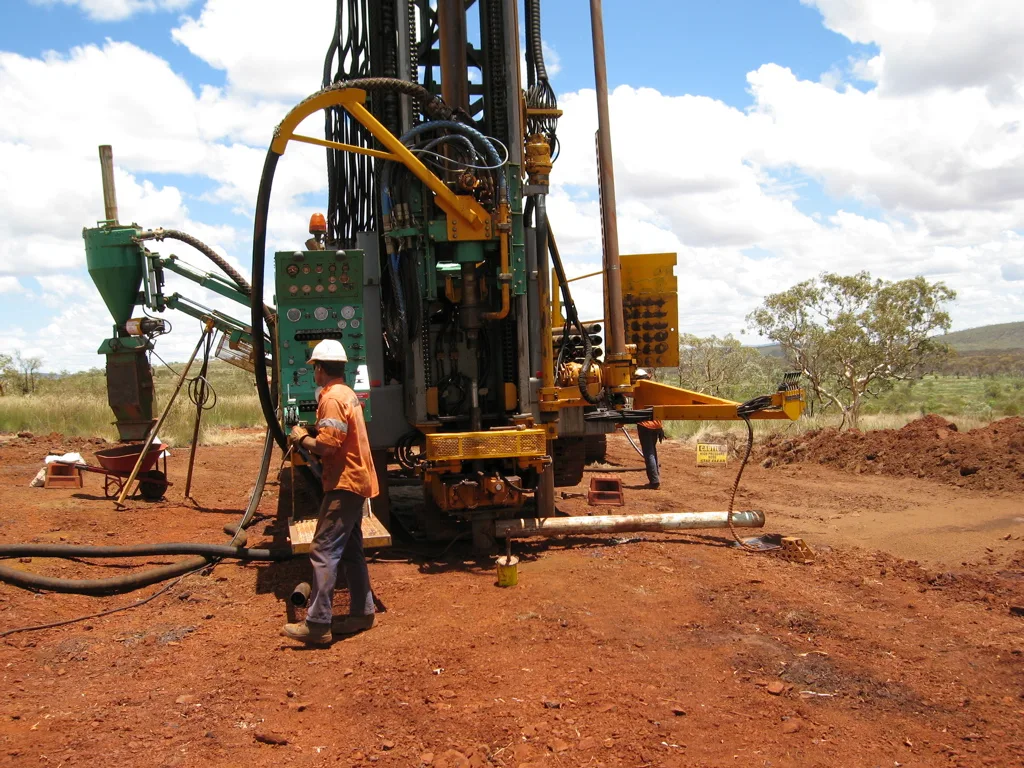
Photo: Blastcube, CC BY-SA 3.0, via Wikimedia Commons.