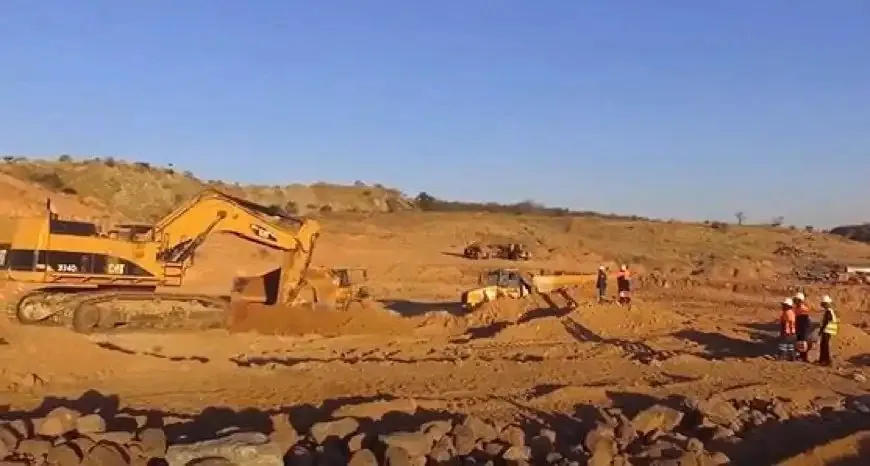
Short answer: Zimbabwe became a major diamond producer by volume after the discovery of the Marange diamond fields in the east of the country in 2006. The deposits are large, but how much of their value has reached public accounts and local communities has been disputed for years. In 2016 the government consolidated the Marange operators into a single state company, the Zimbabwe Consolidated Diamond Company. The lasting question is not whether Zimbabwe has diamonds, but whether its institutions can turn them into broad, auditable benefit.
Few diamond discoveries have changed an industry as quickly as Marange. Within a few years of its discovery, an area of eastern Zimbabwe went from farmland to one of the largest sources of diamonds in the world by volume. It also became one of the most contested, a case study in how mineral wealth and national wealth can diverge.
Where Marange is
The Marange fields lie in Manicaland Province in eastern Zimbabwe, near the city of Mutare and the border with Mozambique. Zimbabwe’s other notable diamond operation, Murowa in the south, is a conventional kimberlite mine, but Marange has dominated national output since it began producing.
Why Marange changed the industry
Most of the world’s famous diamond mines extract stones from kimberlite pipes, the volcanic rock that carries diamonds up from deep in the earth, often hundreds of metres underground. Marange was different. Its diamonds occur in conglomerate rock and near-surface deposits that are easy to reach.
When the extent of the deposits became known in 2006, that easy access triggered a rush. Tens of thousands of informal miners arrived to dig by hand. In 2008 the state moved to take control of the fields, and the military operation that cleared them was accompanied by serious human rights abuses reported by international organisations. Production then passed to several companies operating in partnership with the state.
Volume and value are different
Marange produced a very large number of carats, which pushed Zimbabwe up the rankings of diamond producers by volume. But carats are not the same as value. Much of the Marange output consisted of smaller, lower-quality stones, including industrial-grade material, worth far less per carat than the gems from top kimberlite mines in Botswana, Russia or Canada.
The size distribution of stones, their quality, the cost of recovery and the channels through which they are sold all determine how much money a deposit actually generates. A large flow of carats can coexist with disappointing revenue.
Certification is not the same as full transparency
The Kimberley Process, created in 2003, is an international certification scheme intended to stop rough diamonds that finance rebel movements, known as conflict diamonds, from entering legitimate trade. Marange posed a difficult test for it: exports were suspended for a period after the 2008 abuses, and were later approved again amid controversy among member countries and civil society groups.
Certification matters, but it answers a narrow question. It does not address ownership, labour conditions, environmental performance, the terms of contracts, tax payments or where revenue finally goes. A shipment can meet the scheme’s definition while the public still lacks a complete picture of who benefited.
Where the money went
Questions about revenue have followed Marange since its early years. In 2016, then-President Robert Mugabe said the country had lost as much as 15 billion dollars in diamond revenue, an estimate that was widely reported and difficult to verify. The same year, the government ended the licenses of the existing operators and consolidated mining into the state-owned Zimbabwe Consolidated Diamond Company.
The stated goal was to improve accountability and increase public revenue. Consolidation also introduced uncertainty over licenses, investment and the continuity of operating expertise, and some of the displaced companies disputed the decision. Whether the change has delivered the transparency it promised is still debated.
Why production estimates diverge
Diamond statistics are difficult to compare. Figures may refer to carats recovered, carats sold or export value. Stockpiles, mixed quality and changes in sales channels make year-to-year comparisons harder. Official statistics, company statements and international datasets may cover different periods and definitions.
Responsible coverage states those limitations rather than turning uncertain figures into a precise national windfall or a precise national loss.
From geology to durable value
A diamond industry that lasts needs predictable licensing, independent oversight, safe working conditions, environmental rehabilitation and competitive marketing of stones. Cutting and polishing in the country can keep more value at home, but only where skills, finance and a steady supply of suitable stones exist.
Marange is as much a story about institutions as about geology. Mineral wealth becomes national wealth only when a country can measure production, value it properly, collect the revenue and spend it transparently.
At a glance
| Item | Detail |
|---|---|
| Best-known field | Marange, Manicaland Province, eastern Zimbabwe |
| Discovered | 2006 |
| Deposit style | Near-surface conglomerate and alluvial deposits |
| Main operator since 2016 | Zimbabwe Consolidated Diamond Company (state-owned) |
| Trade framework | Kimberley Process certification |
| Central issue | Transparency of production and revenue |
Frequently asked questions
Where are Zimbabwe’s diamonds mined?
Mainly in the Marange fields in eastern Zimbabwe. A smaller conventional kimberlite mine, Murowa, operates in the south.
Are Zimbabwean diamonds conflict diamonds?
That label is too broad. Individual shipments and operators have to be assessed under the Kimberley Process and applicable law, though Marange’s history raised serious concerns.
Why did Zimbabwe consolidate its diamond companies?
In 2016 the government said it wanted more control and more revenue from Marange, after years of disputes over where diamond income had gone.
Why can a huge diamond deposit produce disappointing revenue?
Because value depends on stone quality and size, recovery costs, leakage, sales terms and governance, not just the number of carats.
Sources and further reading
Photo: Jonathan Dlamini, CC BY-SA 4.0, via Wikimedia Commons.