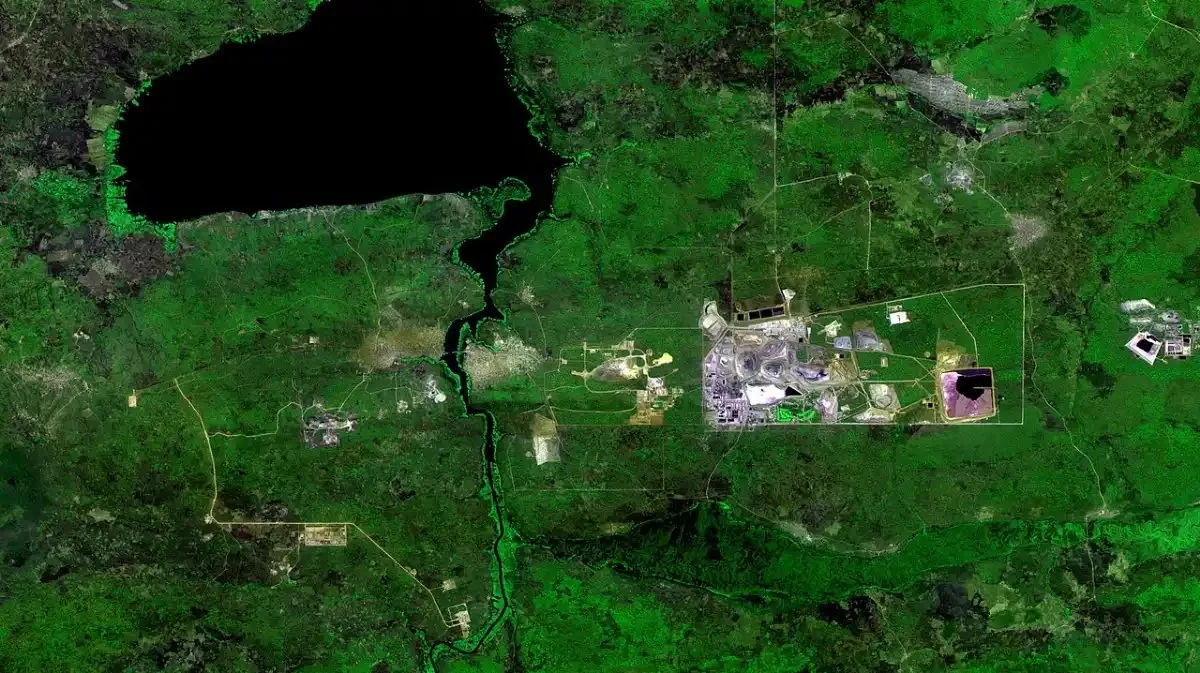
Short answer: Most of the world’s cobalt does not come from cobalt mines. It is recovered as a by-product of copper and nickel mining, and the Democratic Republic of the Congo produces the large majority of mined supply, mainly from large industrial copper and cobalt mines in its southern Copperbelt. Indonesia has become the second major source through nickel processing. Much of the refining happens in China.
Cobalt strengthens the superalloys used in jet engines, gives blue pigments their colour and helps stabilise several lithium-ion battery chemistries. Its supply chain attracts unusual attention for two reasons: production is concentrated in very few places, and most of the metal is a by-product of mining something else.
Where cobalt is mined
The Democratic Republic of the Congo accounts for most of the world’s mined cobalt. The metal comes mainly from the Central African Copperbelt, which runs through the southern provinces of the country and into Zambia. Deposits there combine copper and cobalt at a scale found almost nowhere else, which is why the DRC became central to the battery industry.
Other producers include Indonesia, where cobalt is recovered from nickel laterite deposits through high-pressure acid leaching, along with Australia, the Philippines, Canada, Russia and Cuba. Indonesia’s output has grown quickly and has made it the most important source outside the Congo.
Why by-product status matters
A mine that produces cobalt alongside copper makes its decisions mainly on copper. If copper prices are strong, it may expand and add cobalt supply even when cobalt prices are weak. If copper prices collapse, it may cut output and remove cobalt from the market even when cobalt is scarce.
That structure is why the cobalt market often behaves unpredictably. A high cobalt price does not automatically produce a rapid supply response, because the host mine, the processing plant and the economics of the main metal all have to work first. Nickel operations make the same calculation from a different starting point. Understanding cobalt supply means understanding copper and nickel first.
Industrial and artisanal mining
Large industrial mines, many of them owned or financed by Chinese companies, produce most of the Congo’s cobalt. Alongside them, artisanal mining, where people dig by hand with basic tools, supplies a smaller but significant share and supports many livelihoods in mining regions.
Artisanal mining has been linked to serious safety problems and to child labour, and it has made traceability a central issue for battery makers and car companies. Treating every Congolese tonne as artisanal is wrong, and so is assuming that every industrial supply chain is free of risk. Responsible sourcing depends on knowing exactly where material came from and how it moved, which is the purpose of the due diligence frameworks that buyers increasingly apply.
From mine to battery
Mines in the Congo typically ship cobalt hydroxide or other intermediate products, not battery-ready chemicals. Those intermediates are refined into cobalt sulfate or other compounds, which go into cathode materials, which go into battery cells. A large share of that refining capacity is in China.
That means a company or government seeking a resilient cobalt supply has to look beyond the mine gate. Ownership of mines, refining capacity, chemical conversion and cathode production all matter, and concentration at any one of those stages creates risk.
Can batteries do without cobalt?
Battery makers continually adjust cathode chemistry to balance cost, performance and supply risk. Lithium iron phosphate batteries contain no cobalt at all and have taken a large share of the electric vehicle and storage markets. High-nickel chemistries have reduced the amount of cobalt per battery.
Cobalt-bearing chemistries can still offer advantages in energy density and performance, so they remain important in many vehicles and devices. Lower cobalt per battery does not necessarily mean lower total demand, because the number of batteries keeps growing. The market is a competition among designs rather than a single inevitable direction.
Prices and the market
Cobalt prices have swung widely, rising sharply during periods of expected shortage and falling when Indonesian and Congolese supply grew faster than demand. Because supply is tied to copper and nickel and demand depends on battery choices, both sides of the market can move for reasons unrelated to cobalt itself.
For readers following the market, the useful questions are where new supply is coming from, which battery chemistries are gaining share, and how much processing capacity sits in each country.
At a glance
| Item | Detail |
|---|---|
| Main uses | Battery materials, superalloys, pigments |
| Leading producer | Democratic Republic of the Congo |
| Second major source | Indonesia, from nickel processing |
| Production model | Mostly a by-product of copper or nickel |
| Main refining location | China |
Frequently asked questions
Are all cobalt mines in the DRC?
No. Cobalt is also produced in Indonesia, Australia, the Philippines, Canada, Russia and Cuba, but the DRC remains by far the largest source.
What is artisanal cobalt mining?
Mining done by hand with basic tools outside large mechanised operations. Conditions and legal status vary from site to site, and safety and child labour are serious concerns.
Why does cobalt depend on copper prices?
Because most cobalt is recovered from copper or nickel mines. Their output decisions follow the main metal, which then determines how much cobalt is produced.
Do electric vehicle batteries need cobalt?
Not all of them. Lithium iron phosphate batteries use none, while other chemistries still use cobalt for performance and energy density.
Sources and further reading
Photo: Coordenação-Geral de Observação da Terra/INPE, CC BY-SA 2.0, via Wikimedia Commons.