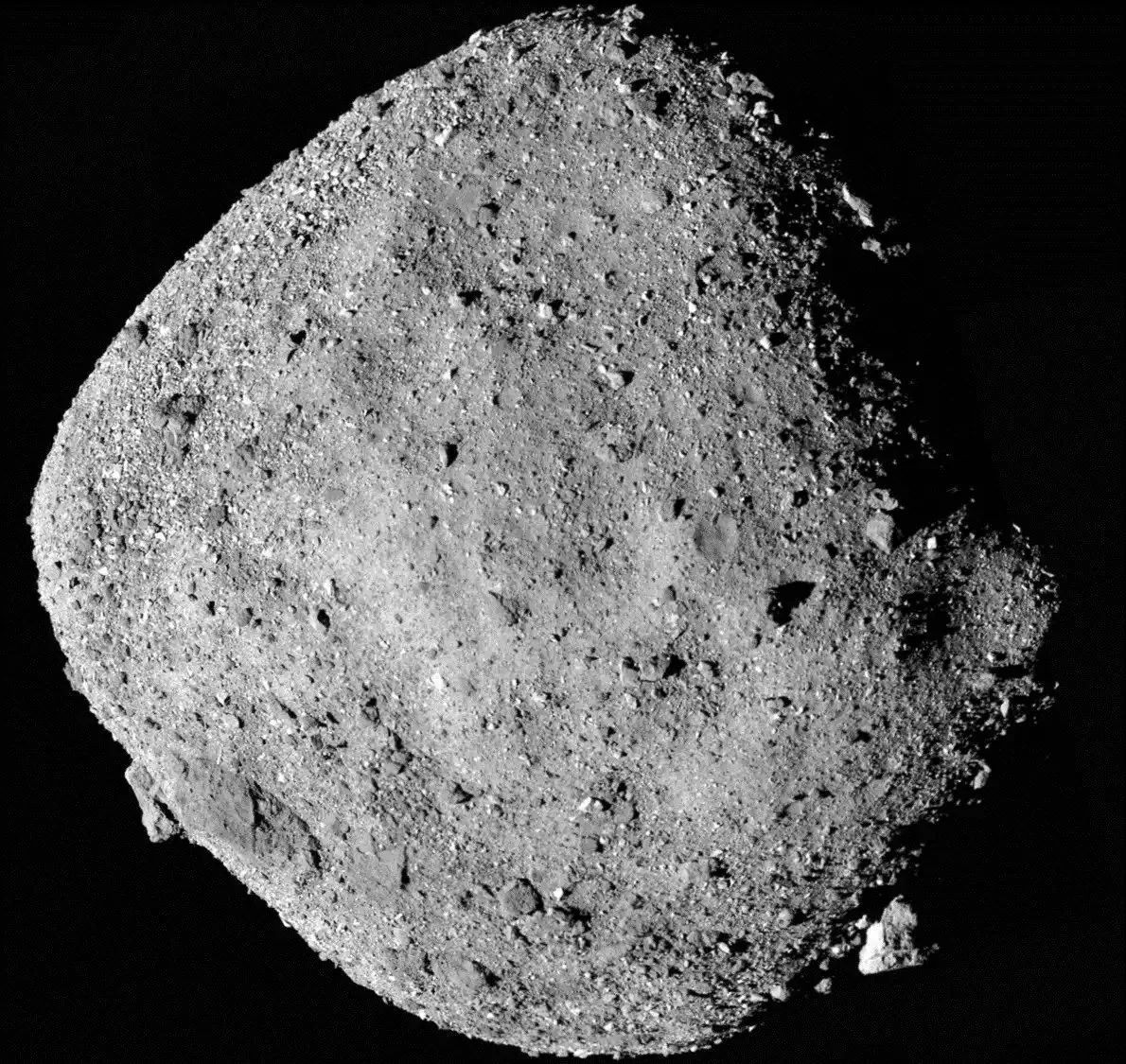
Short answer: Asteroid mining is physically possible but is not yet an industry. No company has mined an asteroid commercially. The hard problems are prospecting, autonomous robotics, processing in microgravity, transport and, above all, finding a buyer whose price justifies the mission. The first real market is more likely to be water used in space than platinum sold on Earth.
The phrase “asteroid mining” brings to mind a spacecraft returning to Earth loaded with platinum. The commercial logic that most researchers and space agencies take seriously is far less cinematic: extracting water and construction material for use beyond Earth, where avoiding the cost of launching them from the planet’s surface could be worth a great deal. Understanding why that distinction matters is the key to reading every headline about trillion-dollar asteroids.
A resource is not a reserve
Spectroscopy from telescopes and the composition of meteorites that fall to Earth show that asteroids contain metals, silicate rock and, in some cases, water-bearing minerals. That makes them a resource in the geological sense: material of potential value exists. It does not make them a reserve.
In mining, a reserve is the part of a deposit that can be extracted, processed and sold at a profit under realistic technical and economic assumptions. On Earth, moving a deposit from resource to reserve takes years of drilling, sampling, metallurgical testing and cost estimation. For an asteroid, almost every one of those steps has never been carried out at commercial scale, and some of them, such as processing ore in microgravity, have not been demonstrated at all.
Why headline valuations mislead
The figures that circulate in popular coverage are usually produced by multiplying the estimated mass of an asteroid by the current price of a metal on Earth. The result is spectacular and tells an investor almost nothing.
Grade is uncertain until the body has been sampled. Only a fraction of any deposit is recoverable. Processing, transport and time all cost money. And a sudden supply of a metal as thinly traded as platinum would push down the very price used in the calculation. A credible valuation has to include discovery, extraction, processing, delivery, risk and the location of the customer, which is exactly what the headline number leaves out.
Water may come before precious metals
Water is the resource that changes the economics. It can support crews, provide radiation shielding and, once split into hydrogen and oxygen, become rocket propellant. Every kilogram of water used in orbit today has to be launched from Earth, which is expensive.
If water can be obtained from an asteroid and delivered to where it is needed in space for less than the cost of launching it, the customer is another space operation rather than a buyer on Earth. That avoids the difficulty of bringing material back through the atmosphere and avoids competing with established mines on Earth. It also depends on something that does not yet fully exist: an in-space economy large enough to buy the output regularly.
Prospecting comes first
Remote observation can identify broad composition, but it cannot fully describe the mechanical strength of the material, the size of its particles or how water is distributed through it. Those properties determine what equipment will work. A credible campaign therefore needs close survey and sampling before any mining system is designed.
Scientific missions have shown that this is possible. Japan’s Hayabusa and Hayabusa2 missions returned samples from the asteroids Itokawa and Ryugu, and NASA’s OSIRIS-REx returned material from Bennu in 2023. These were research missions designed to collect grams of material, which is a very different objective and cost structure from extracting tonnes. But they proved that spacecraft can reach, touch and sample small bodies.
Engineering in microgravity
Digging on an asteroid is not like digging on Earth. Gravity is so weak that the force of a drill or scoop can push the spacecraft away instead of breaking the rock. Loose material can float off rather than falling into a bin. Equipment has to anchor itself, contain what it extracts and operate largely on its own, because communication delays make remote control from Earth impractical for fine work.
Power, heat management and maintenance add further constraints. A mining system that breaks down cannot be visited by a repair crew. These are solvable engineering problems in principle, but each one adds cost and risk, and none has been solved at commercial scale.
Law and finance
The legal framework is partly settled. The Outer Space Treaty of 1967 prevents any nation from claiming sovereignty over a celestial body. The United States passed a law in 2015 recognising the right of its citizens to own resources they extract in space, and Luxembourg followed with its own law in 2017. The Artemis Accords, signed by a growing group of countries since 2020, also address resource extraction.
Legal permission, however, does not make a project bankable. Investors still need a technically credible mission plan, insurance, customers and a way to survive very long development cycles. Two well-funded asteroid mining start-ups of the 2010s, Planetary Resources and Deep Space Industries, were both acquired before mining anything, which shows how hard the financing problem is.
What progress will look like
The industry is unlikely to arrive in a single leap. Progress is more likely to come through a series of smaller demonstrations: better prospecting missions, tests of extraction equipment, in-space use of water and, eventually, small-scale production for a specific customer.
NASA’s Psyche mission, launched in 2023 to study a metal-rich asteroid, is a reminder that scientific interest and commercial interest overlap but are not the same. Learning what an asteroid is made of is the first step. Turning that knowledge into a mine is a much longer road.
At a glance
| Item | Detail |
|---|---|
| Current status | Research and technology development |
| Commercial mining to date | None |
| Most likely first market | Water and materials used in space |
| Common mistake | Treating gross metal value as recoverable profit |
| Key legal texts | Outer Space Treaty (1967), US law (2015), Luxembourg law (2017) |
Frequently asked questions
Has anyone mined an asteroid commercially?
No. Scientific missions have returned small samples from Itokawa, Ryugu and Bennu, but those were research projects, not commercial extraction.
Why is water more important than platinum for asteroid mining?
Because water can be used in space for life support and rocket propellant, where it is expensive to launch from Earth. A buyer in orbit may pay more for it than any buyer on Earth would pay for asteroid metals.
Is asteroid mining legal?
Some countries, including the United States and Luxembourg, recognise rights over resources extracted in space. The Outer Space Treaty prevents claims of sovereignty over the asteroid itself.
Would asteroid mining make precious metals worthless?
That claim ignores recovery cost, mission risk and the size of the market. Large new supply would lower prices, which in turn would reduce the value of the mission.
Sources and further reading
Photo: NASA/Goddard/University of Arizona, public domain, via Wikimedia Commons.