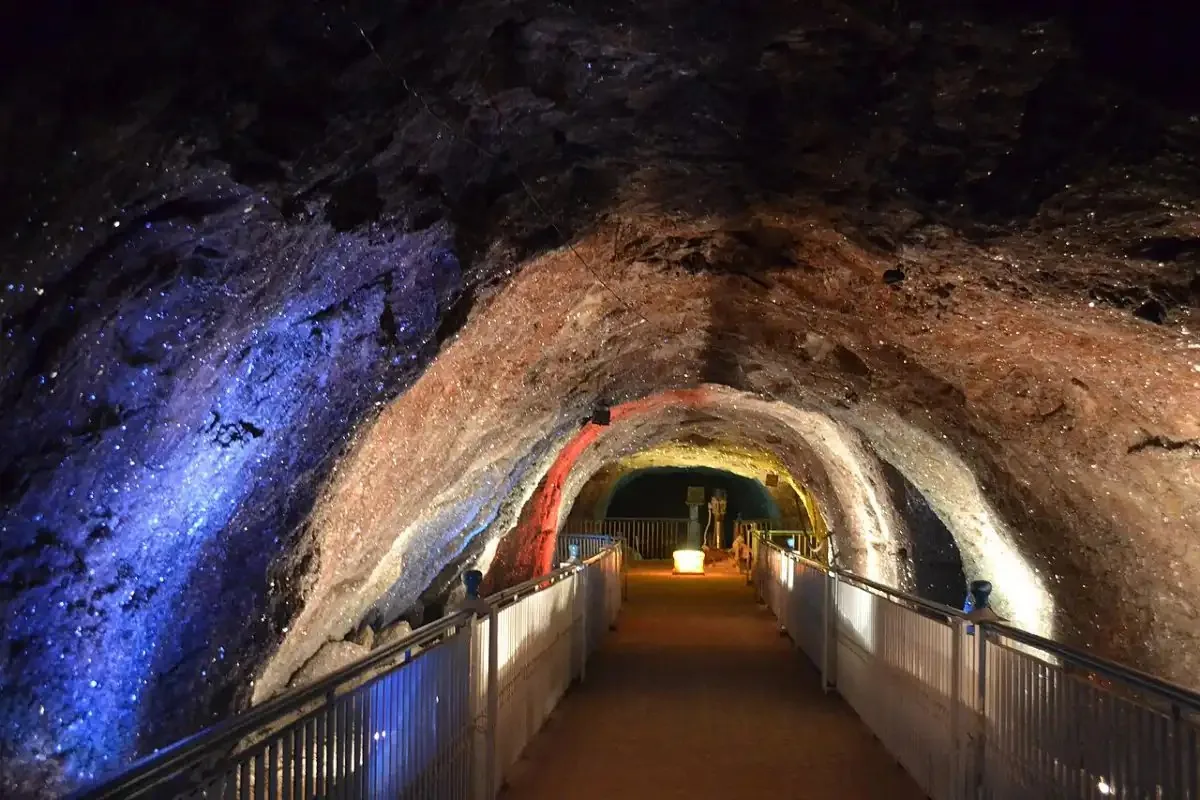
Short answer: The best-known pink salt mine is the Khewra Salt Mine in Pakistan’s Punjab province, the main source of the salt sold worldwide as Himalayan pink salt. Despite the name, the mine is not in the Himalayas but in the Salt Range, a line of hills roughly 300 kilometres to the south. The pink colour comes from traces of iron and other minerals in the rock salt.
Khewra lies in Pakistan’s Salt Range, a line of hills in northern Punjab. Its pink and reddish rock salt is sold around the world as Himalayan salt, a label that is broader and more romantic than the mine’s real location. Khewra is also one of the few working mines that millions of people have visited.
Where Khewra is
The mine is near the town of Khewra in the Jhelum District of Punjab, about 160 kilometres south of Islamabad. It sits in the Salt Range, which contains thick layers of rock salt laid down hundreds of millions of years ago when ancient seas evaporated.
Khewra is one of the oldest salt mines in the world still in operation. Local tradition holds that the salt was discovered when horses belonging to Alexander the Great’s army were seen licking the rocks, though large-scale mining began much later. The mine is operated by the state-owned Pakistan Mineral Development Corporation.
Why the salt is pink
Pure halite, the mineral name for rock salt, is colorless or white. The pink, orange and red shades of Salt Range salt come from tiny amounts of iron oxide and other minerals trapped in the crystals.
The colour varies within the deposit, from almost white to deep red, and between individual blocks from the same seam. It is a visual feature, not a measure of quality or nutritional value.
How Khewra is mined
Khewra uses the room-and-pillar method. Miners cut chambers, or rooms, into the salt while leaving large pillars of salt standing to support the roof. Roughly half of the salt in a mined area is left in place as pillars.
The method creates the vast, geometric underground spaces that visitors see, with long tunnels and high chambers carved out of solid salt. The mine has many levels and kilometres of tunnels, and extraction continues today alongside tourism.
A mine people visit
Khewra is a major tourist attraction in Pakistan. A small train carries visitors into the mine, where they can see illuminated chambers, a pool of brine, and structures built from blocks of translucent salt, including a small mosque made of salt bricks and models of well-known landmarks.
The salt walls glow when lit from behind, which has made images of the mine widely recognised. That visibility helped turn Khewra into the public face of a global consumer product: people can connect a jar in their kitchen to a real place and the work that produced it.
“Himalayan” is a marketing name
The Salt Range is a distinct geological and geographical feature, separate from the Himalayas. Retail packaging uses “Himalayan” because it is memorable and suggests purity and altitude. Accurate descriptions name Khewra and the Salt Range rather than implying that miners work beneath snowy peaks.
Not every pink salt comes from Khewra, either. Other mines in the Salt Range produce similar salt, and pink salts are mined elsewhere in the world. Buyers who care about origin have to rely on the supplier’s information.
Health claims versus composition
Pink salt is often marketed with claims that it contains dozens of trace minerals and is healthier than ordinary table salt. It does contain small amounts of other elements, which is what gives it colour. But it is still overwhelmingly sodium chloride, typically well above 95 per cent.
At normal serving sizes, the trace minerals are present in amounts too small to make a meaningful nutritional difference. Pink salt also usually lacks the added iodine found in iodised table salt. Taste, texture and appearance are good reasons to choose it; broad health and detoxification claims are not supported by its composition.
Salt beyond the kitchen
Only part of the salt from the Salt Range ends up on dining tables. Large blocks are cut into lamps, cooking slabs and decorative items, and lower grades are used for animal licks and industrial purposes. The global market for these products has grown steadily, much of it supplied from Khewra and nearby mines.
At a glance
| Item | Detail |
|---|---|
| Mine | Khewra Salt Mine |
| Country | Pakistan |
| Location | Jhelum District, Punjab, in the Salt Range |
| Operator | Pakistan Mineral Development Corporation |
| Commodity | Rock salt (halite) |
| Mining method | Room and pillar |
| Known for | Pink salt sold as “Himalayan” |
Frequently asked questions
Where does pink Himalayan salt come from?
Mostly from the Khewra Salt Mine and other mines in Pakistan’s Salt Range, which lies south of the Himalayas rather than in them.
Why is Himalayan salt pink?
Because of tiny amounts of iron oxide and other minerals trapped in the salt crystals.
Is pink salt healthier than ordinary salt?
Not in any significant way. It is still mostly sodium chloride, and its trace minerals are present in very small amounts. It usually lacks added iodine.
Can you visit the Khewra Salt Mine?
Yes. It is one of Pakistan’s best-known tourist attractions, with a train and guided routes through illuminated chambers.
Sources and further reading
Photo: Shikari7, CC BY-SA 3.0, via Wikimedia Commons.