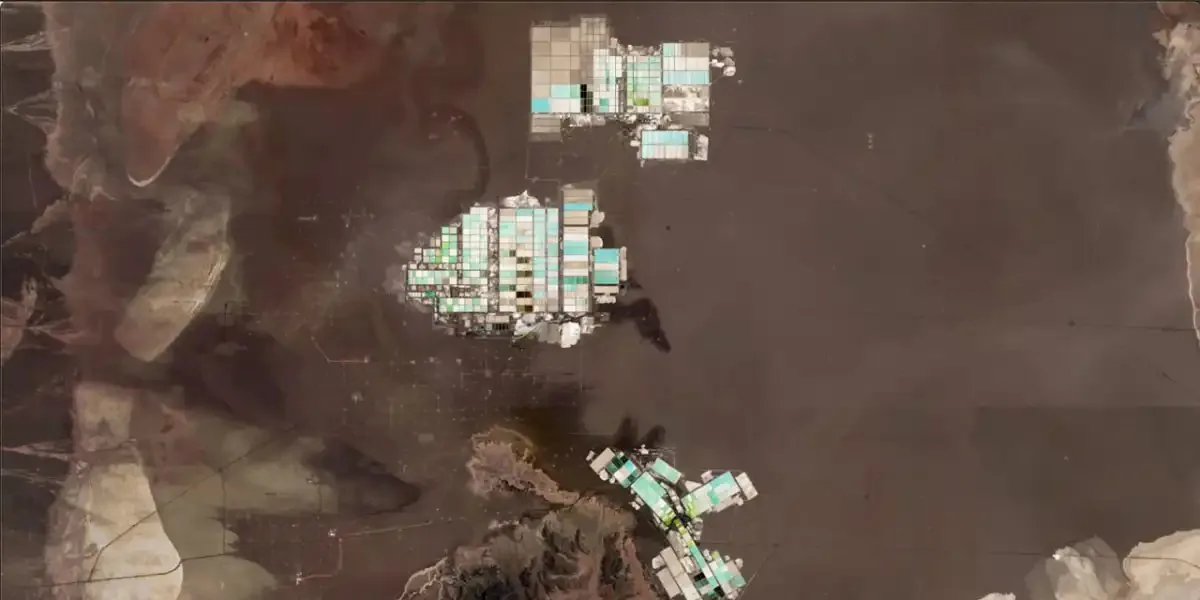
Short answer: The Salar de Atacama is a large salt flat in the Atacama Desert of northern Chile, about 2,300 metres above sea level, and one of the world’s most important sources of lithium. Lithium-rich brine is pumped from beneath the salt crust into evaporation ponds, where the sun concentrates it before it is refined into lithium chemicals. The two main operators have been SQM and Albemarle. Its importance comes with hard questions about water in an extremely dry ecosystem.
The Salar de Atacama is a vast basin of salt and sediment in northern Chile. Beneath its crust lies brine rich in lithium and potassium, and above it sit some of the strongest sunshine and driest air on earth. That combination has made it one of the world’s leading sources of lithium for batteries, and one of the most closely watched places in the debate over how lithium should be produced.
Where the salar is
The salar lies in the Antofagasta Region, east of the town of San Pedro de Atacama and close to the Andes. It covers roughly 3,000 square kilometres, making it the largest salt flat in Chile, and sits at about 2,300 metres above sea level. Lagoons and wetlands at its edges support flamingos and other wildlife, and Indigenous Atacameño, or Lickanantay, communities have lived around it for thousands of years.
Why this salar became globally important
Not all lithium brines are equal. The Salar de Atacama has high lithium concentrations compared with most other brines, very high evaporation rates thanks to intense sun and wind, low rainfall and established infrastructure built over decades. Together these make it one of the lowest-cost sources of lithium anywhere.
Chile has long been one of the world’s two largest lithium producers, alongside Australia, and most of its output comes from this one basin.
Lithium is not the desert’s only prize. Some 120 kilometres to the south-west lies Escondida, the largest copper mine on earth, whose annual output has been priced at about $18.5 billion a year, more than any other single mine produces.
From brine to lithium chemicals
The process starts with wells that pump brine from beneath the salt crust. The brine flows into a long sequence of large, shallow ponds. Over many months, sun and dry air evaporate water, and different salts crystallise out in turn. Potassium salts are harvested along the way and sold as fertiliser.
By the final ponds, the brine has become a concentrated lithium solution. It is trucked to chemical plants near the city of Antofagasta, where it is purified and converted into lithium carbonate or lithium hydroxide, the forms that battery makers buy.
Why chemistry matters
Brines differ in their lithium concentration and in the other elements they contain, especially magnesium, which has to be removed and makes processing harder. The ratio of magnesium to lithium, along with potassium, sulfate and boron content, influences how much of each reagent is needed, how much lithium is recovered and which products can be made.
The Salar de Atacama’s favourable chemistry is a large part of why its production costs are low.
Brine is not an underground lake
A common misunderstanding is that the brine sits in a hidden lake under the salt. In reality it fills the pores and fractures of saline sediments and rock beneath the surface. The basin is a connected hydrological system: the brine at the centre interacts with less salty groundwater at the edges, which in turn feeds the lagoons and wetlands.
Pumping brine changes pressures and flows within that system. The scientific debate is about how quickly and how much those changes reach the fresher water and the ecosystems that depend on it.
The water debate
Operators often stress that brine is not fresh water and is not drinkable. Critics respond that removing brine can still affect the water balance of the whole basin, and that operations also use freshwater from the surrounding area. Both points can be true at once.
Useful discussion depends on definitions. Any figure about water use should state whether it covers brine extraction, industrial freshwater, water for camps and towns, or total demand in the basin. Rainfall, evaporation and the long response times of groundwater make short monitoring records hard to interpret. Indigenous communities have pressed for independent monitoring, access to data and a real role in decisions, and those questions are central to the salar’s future.
Evaporation versus direct extraction
Direct lithium extraction, or DLE, is a group of technologies that remove lithium from brine more selectively, often in hours rather than months, and return the depleted brine underground. It could reduce the land taken up by evaporation ponds and the amount of brine lost to evaporation.
DLE still needs water, energy and chemical reagents, and reinjecting brine without disturbing the basin has to be proven at scale. It should be assessed as a family of technologies with different trade-offs, not as a universal zero-impact replacement for ponds.
Who operates there
Lithium extraction at the salar has been carried out mainly by SQM and Albemarle, under contracts with the Chilean state agency that owns the mineral rights. Chile’s national lithium strategy, announced in 2023, gave the state a larger role, and the state copper company Codelco agreed to form a joint venture with SQM to operate at the salar in the coming decades. The rules governing the basin, including environmental conditions and community benefits, continue to evolve.
At a glance
| Item | Detail |
|---|---|
| Location | Antofagasta Region, northern Chile |
| Altitude | About 2,300 metres |
| Resource | Lithium- and potassium-bearing brine |
| Process | Brine pumping, solar evaporation, chemical refining |
| Main operators | SQM and Albemarle |
| Key constraint | Water balance and ecosystem protection |
Frequently asked questions
Is the Salar de Atacama a mine?
It is a mineral extraction operation that pumps brine from beneath a salt flat, rather than a conventional open pit or underground mine.
Why is the Salar de Atacama so important for lithium?
It combines high lithium concentrations, very strong evaporation and established infrastructure, making it one of the lowest-cost lithium sources in the world.
Does lithium extraction use water from the desert?
It removes brine, which is not fresh water, and operations also use some freshwater. How brine pumping affects the basin’s fresher water and wetlands is the core of the debate.
What is direct lithium extraction?
A group of technologies that take lithium from brine selectively and return the rest underground, which could reduce the need for evaporation ponds.
Sources and further reading
Photo: NASA's Scientific Visualization Studio, public domain, via Wikimedia Commons.